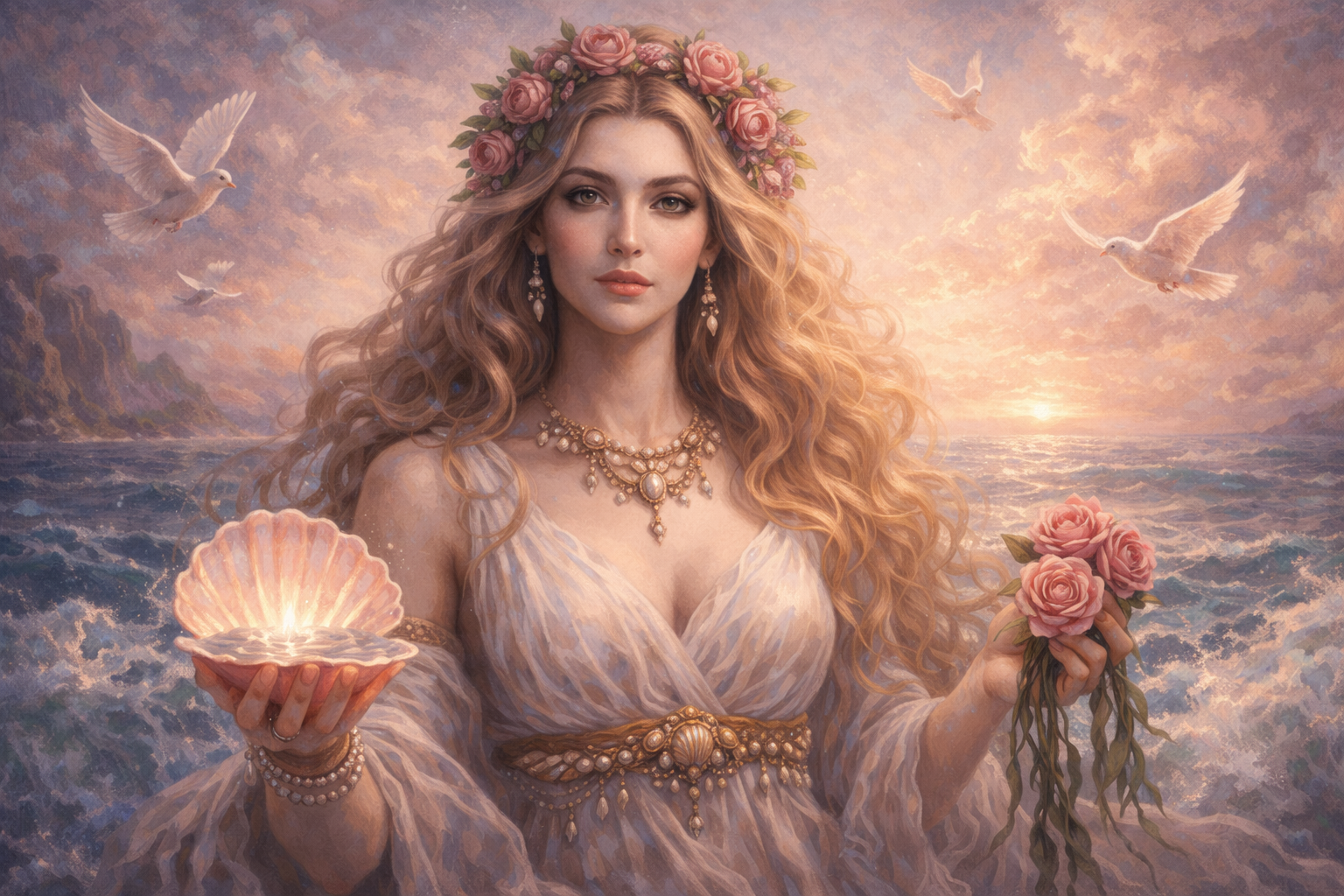
aphrodite/venus
aphrodite / venus: born from the deep
There are two versions of Aphrodite's origin story, and the difference between them tells you everything about what happened to her over time.
The older story — the one that predates the Olympian pantheon — goes like this: Cronus takes a sickle and severs Uranus from the sky. Where the severed flesh falls into the sea, foam gathers. And from that foam — from that primordial churning of sea and sky and ancient violence — Aphrodite is born. She steps out of the ocean fully formed. No mother. No father. No one who made her or owns her or gets to claim her. She belongs to the deep. She belongs to herself.
This is the original Aphrodite. Pre-Olympian. Pre-patriarchal. She is not a daughter. She is not a wife. She is desire itself, arising from the body of the cosmos before the gods had sorted themselves into hierarchies.
And then there is the Homeric version. In this telling she is the daughter of Zeus and a sea nymph named Dione. She has a father. She is legible. She fits inside the structure.
This is what patriarchy does to power it cannot metabolize. It doesn't always destroy — sometimes it simply rewrites the origin story. Gives her a father. Makes her manageable. Turns something that arose from the primordial deep into someone's daughter.
This is the first wound.
The Olympian Aphrodite is given a husband: Hephaestus, the god of the forge. Zeus arranges the marriage. The goddess of love and desire — the one who was born belonging to no one — is handed to a husband she did not choose. And she keeps choosing Ares. The god of passion, of raw embodied aliveness. She keeps returning to the love that moves through her body, that meets her at the level of her actual nature. The mythology frames this as betrayal, as shameful. But read differently: she refuses to let herself be fully domesticated. She keeps choosing the one who makes her feel alive. That is not weakness. That is sovereignty.
Somewhere along the way, the goddess whose power reshapes civilizations becomes reduced to vanity. The golden apple. The judgment of Paris. The Trojan War. Her fault. But look at what is actually happening in those stories. Her power — the power of desire, of beauty, of profound magnetic force — moves through the world, and things happen. Empires fall. Men make catastrophic choices. And instead of reckoning with the enormity of what she actually is, patriarchy makes her small. Calls her vain. Blames her for what human beings do in response to the force she carries.
The goddess of soul-level longing becomes the goddess who cares too much about her looks. This is the second wound.
Then there is Psyche. Aphrodite is often cast as the villain of Psyche's story — jealous, cruel, giving impossible tasks as punishment. But look again. Psyche is so beautiful that mortals have begun worshipping her as Aphrodite. Her temples are going cold. Aphrodite's anger is not petty jealousy — it is a goddess watching her sacred role be transferred to someone who cannot hold it. And the tasks she gives Psyche — sorting seeds, gathering golden fleece, descending to the underworld — these are initiations. Brutal, yes. But Psyche emerges from them divine. She becomes immortal. She ascends.
Aphrodite as villain is the patriarchal reading. Aphrodite as initiator — as the force that broke Psyche open so she could become who she was always meant to be — that is the older, deeper truth. That is the Aphrodite who belongs to the mystery tradition.
There are two Aphrodites in the ancient tradition. Not two separate goddesses, but two faces of the same one. Aphrodite Urania — celestial, soul-level love, the longing that is actually spiritual hunger, the desire that points toward your truest self. And Aphrodite Pandemos — earthly, embodied, carnal love. Appetite. Pleasure. The sacred in the physical. Patriarchy took these two and ranked them. Spiritual love elevated and pure. Bodily desire base and shameful. But she was never split. She held both. She was always both.
When Rome absorbed Greek religion, Aphrodite became Venus — who carried her own older Roman qualities, more rooted in gardens, abundance, and the fertile earth. What we carry now in the astrological Venus is both of them. The celestial and the earthly. The longing and the pleasure. Your body as altar. Your desire as devotion. Worth that does not have to be earned.
Her power was never the problem. It was always the power they couldn't hold.
desire, embodied worth, sacred pleasure, soul-level longing, beauty as power, reciprocal love, the initiator, Urania and Pandemos, Venus
Working with Venus Energy
When to call upon her:
When reconnecting with desire you have made small or apologized for
When reclaiming pleasure as sacred rather than indulgent
When your relationship to your own worth needs tending
When you are giving love without receiving it in return
When creative or erotic energy feels blocked or shamed
When you need to remember that your body is the altar
When navigating relationships and asking what you actually value
When Pluto or Venus transits are active in your chart and asking for transformationEmbodiment practices:
Embodiment practices:
Slow sensory immersion: food, scent, touch, music — presence in the body's pleasure
Mirror work: sustained eye contact with yourself without judgment
Hand on heart, hand on belly: breathing into both Urania and Pandemos simultaneously
Movement that is not exercise but pleasure — dancing alone, stretching without goal
Creating beauty in your environment as devotional practice
Asking your body what it desires before asking what it needs
Sitting with the question: what have I been withholding from myself in service of being palatable?
Receiving practice: allowing compliments, care, pleasure to land without deflecting
Altar suggestions:
Rose quartz, malachite, or emerald (her stones)
Roses, myrtle, or apple blossoms (her sacred plants)
Copper items (her metal)
Doves or sparrow imagery (her sacred birds)
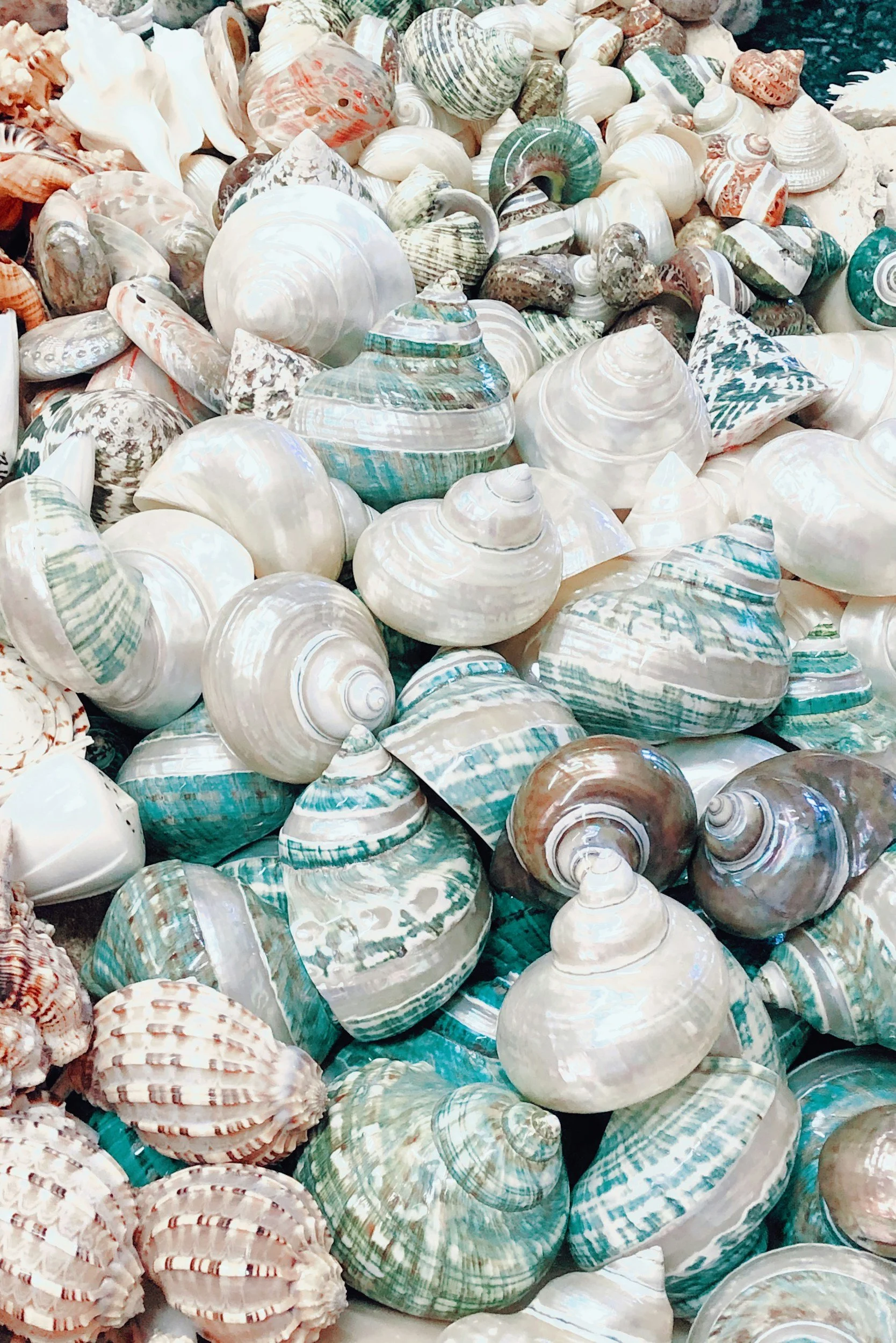
Seashells and ocean water (honoring her birth from the deep)
Mirrors (she is the goddess of self-reflection as well as beauty)
Venus symbol ♀
Pink, gold, or deep red candles
Honey, wine, or pomegranate as offerings
Anything that represents what you genuinely desire
Reflection questions:
Where have I made my desire small so someone else would be comfortable?
How do I relate to my own body — as something to manage, or as an altar?
Where am I giving love without receiving it in return, and what would reciprocity actually look like?
What is the difference between performing worthiness and inhabiting it?
How do I hold Aphrodite Urania (soul-level longing) and Aphrodite Pandemos (embodied pleasure) without ranking one above the other?
What would I claim if I knew my desire was sacred rather than shameful?
discover YOUR GODDESS astrology
Curious where the goddess asteroids are located in your birth chart?